
The rupee had lost more than 8 per cent since the first week of May, after the US Fed indicated it may start scaling back its monetary stimulus programme later this year.

'What is critical today in India is confidence of depositors.' 'If you have these kinds of problems spreading like this, the confidence level of a lot of people in the system gets shaken.'

The plea also sought a directive for the constitution of a committee of experts who would find the details of bad debt cases in the country.

India builds up record FX after Fed hints rate hike in future.

The rupee had surged 37 paise to end at a nine-month high of 59.68 against the dollar on Tuesday. Forex market remained closed on Wednesday for 'Buddha Purnima'.

A quick bounce back of the Chinese stocks looks improbable now.
The ministry seeks to make lending requirements flexible for banks financing key stalled projects.

Details of identity and residence will not be required for exchange of notes between April 1 and June 30.

'We feel there is definitely something murky in the system.' 'Will anyone believe that Nirav Modi will go to a branch and bribe a low-level officer?' 'Just look at the people with whom he had moved around.'

India does not have a unified regulatory regime to counter Ponzi, or pyramid, schemes whose operators typically grab new deposits to meet their promise of guaranteed returns to existing savers, point out Manoj Kumar and Mayank Bhardwaj.

Of the 2,562 customer complaints received between January 2020 and March 2021, a majority relate to illegal apps. At least two dozen suicide cases have been reported, perpetrated by the harassment by loan app operators, points out Tamal Bandyopadhyay.
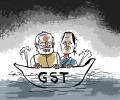
If the items and services such selected subsequently pass the test from the fitment committee and the GST Council, this would be the first of such rate hikes, after a series of cuts in the process of rate rationalisation that started in November 2017.

"A very easy solution to suggest is tax-payers must pay because the private sector has defaulted," Jaitley said, adding that bank recapitalisation, where the government puts in more capital in public sector banks to shore up their books, effectively amounted to that. "Therefore, I think let's try and make the private sector pay for their debts or allow somebody else to step in."

On the revenue front, the finance ministry was expecting higher proceeds from non-tax revenue.

Urjit Patel panel wanted all members to be appointed by RBI

The financial crisis has challenged the intellectual assumptions on which previous regulatory approaches were largely built, and in particular the theory of rational and self-correcting markets.
.jpg)
The rupee on Friday touched an all-time low of 62.03 to a dollar, spooking the equities market and dragging the Sensex down to 18,621.39 in the afternoon.
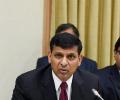
Reserve Bank of India (RBI) Governor Raghuram Rajan has set himself a target of lowering consumer inflation and is even ready to raise rates to achieve it, risking friction with the new government, if he is seen as overstepping.

Prime Minister Narendra Modi will hold discussions with public sector banks (PSBs) and financial institutions to draw up an action plan for banking reforms

The first signs of growing bonhomie between Modi and Rajan came early last year, when Modi called Rajan the "best teacher" for explaining complex economic issues to him.

Jaitley said note ban has compelled people to deposit money into bank accounts.

Experts said a future rate cut would depend on the inflation.

The bank's response came to a clarification sought by stock exchange on recent reports on debit cards blocking in the wake of suspected data breach

Textile exports are expected to reach $50 billion by 2014-15 on the back of new markets.

Jayshree P Upadhyay ' Mumbai September 9, 2014 Last Updated at 22:50 IST Top Stocks to Buy in 2014 8-10 Best Stocks for 2014 per month Highly Accurate Calls, Free Trial stockaxis.com/Stocks-to-buy-in-2014 Ads by Google 3 Add to My Page RELATED NEWS Foreign investor cap in bourses may be raised Sebi sets foreign portfolio investor limit of 10% per firm Sebi move on FPI regime grounded No clarity yet on FPI regime Jaimini Bhagwati: Correcting tax and disclosure anomalies Karbonn Titanium S5 Plus Be 1st to own latest Android phone with Dual SIM, 8 MP Camera & more!www.karbonnmobiles.com/S5_Plus 1Cr Life Cover @ Rs 543* Compare Premium of 46 Insurers Buy Online and save upto 55%www.policybazaar.com/TermInsur_Rate Ads by Google In a move that could increase the stake of foreign investors in Indian stock exchanges, the government is considering a threefold increase in the single-investor investment ceiling. Currently,a foreign portfolio investor (FPI) investment in an exchange is capped at five per cent. The finance ministry has written to the regulatory authorities to increase the ceiling to 15 per cent, said sources. The proposal is said to have in-principle approval from the Securities and Exchange Board of India (Sebi) and the Reserve Bank of India (RBI). The move would bring the FPI investment limit in line with those for financial institutions such as insurance companies and banks. NEW POLICY IN THE WORKS Single foreign investor limit in exchanges to be revised from 5% to 15% Sebi and RBI have given in-principle approval to the proposal Government to amend foreign investment policy BSE has 8 foreign shareholders holding 31% stake NSE has close to 20 foreign shareholders holding 36% stake The government allowed the foreign investors to invest in stock exchanges in 2006, with an overall cap of 49 per cent. This latter cap is likely to be unchanged. BSE and the National Stock Exchange (NSE), the two large nationwide bourses, are likely to benefit from the increase in limits. BSE has eight foreign investors, which cumulatively own about 31 per cent in it. The shareholding of Deutsche Boerse Group and Singapore Exchange Ltd are a little below the five per cent ceiling. NSE has about 20 foreign shareholders, holding around 36 per cent. Cyprus' Gagil and Goldman Sachs own five per cent each; Citi Group has around two per cent. "The finance ministry has received representations stating that the present limit of five per cent is a deterrent in attracting long-term anchor and strategic foreign investors in stock exchanges. Following which, the ministry has sought comments from both Sebi and RBI," said a person privy to the matter. A higher foreign investor limit will not only encourage more investment in Indian bourses but help in exchange of technology and products, said exchange officials. "A five per cent limit on the shareholding of any single investor or investor group is too small to encourage them to take sufficient interest in growth of the exchange," said an official associated with one, asking not to be named. The regulator and the government are also mulling a change in the shareholding of clearing corporations, which could also see individual foreign investors' cap being increased to 15 per cent. Some sections of the market believe that allowing a single FPI to own 15 per cent in a exchange could be detrimental to having a diversified shareholding. The Bimal Jalan committee, in the previous review of ownership and governance of stock exchanges in 2010, had debated whether there was a need to revise the cap. It was in favour of having an anchor investor, such as a bank or financial institution, which would own up to 24 per cent. Read more on: Fpi ' Sebi ' Rbi ' Nse ' Foreign Investor ' Singapore Exchange ' Finance Ministry Read More Investors vie for shares of stock exchanges Pick-up in sentiment, volumes boost bourses' unlisted shares HDFC Life Click2Protect+ Get Lump Sum + Monthly Income Benefit* @ Affordable Rate. Buy Now hdfclife.com/Click2ProtectPlus Retirement Calculator Plan Your Retirement Online in 2Min Calculate & Compare Premium Here! policybazaar.com/Retirement Ads by Google Advertisements Get a freedom to choose your own plan. Click here to know more... Data transforming the match-making business. click here Open a free Trading & Demat A/c with Sharekhan Leadership and Corporate Accountability-India. Click here Great fares to Europe from INR 54,000* Amsterdam. Click here Start Investing with the best Broker in india Important Facts about Infant Hearing Screening Gifting Solutions. Make easy & perfect! Find out what converged solutions can do for you. Smart Cloud Virtualized Server Recovery. Learn more. The perfect drive the perfect style. Book a test drive 3 Add to My Page Back to Top Quick Links Go LATEST NEWSAll NewsIn this section Ebola threatening Liberia's existence, minister warns IS threatens to assassinate Twitter employees Motherson Sumi, Eicher Motors, TVS Motor gain inclusion in F&O segment ABG, Bharati Shipyard rallies on hopes of government sops Pre-market: Five stocks to watch out for in trade today US manufacturing industry pushes India for free trade Dollar gains on Fed outlook, hurts shares Wall St ends lower as Apple shares fall post launch Ukraine ceasefire 'mostly holding': US Flipkart launches third private label Citron News you can use Rss icon Errors to avoid when filing returns What is Gratuity? What are NEFT and RTGS? Check your Income Tax Credit credit status form-26AS online Saving capital gain tax on sale of property Calculate tax on your house property income How to Check your EPF Balance & status online Featured Videos iPhone killers? The biggest threats to Apple's dominance video Jaguar takes the battle to BMW video The 5 biggest IPOs in U.S. history video Here is the next-gen spy plane... a blimp video MOST POPULARReadSharedCommented Supreme Court reserves order on coal block allocations Apple launches Watch, two iPhones & Apple Pay Guj rains: Hundreds evacuated in Vadodara, Army on stand-by Neel Mukherjee's book in Man Booker shortlist Mumbai airport keeps airlines guessing on Airbus A380 parking bay Market News A fourth of mutual fund equity assets concentrated in 10 stocks ICICI Bank, HDFC Bank, Infosys, SBI and L&T among fund managers' preferred bets Den Networks: Investing in new growth avenues Its tie-up with Snapdeal to launch a shopping TV channel looks like a win-win deal Sensex, Nifty retreat from record highs on profit taking The BSE Sensex and Nifty fell on Tuesday from their record highs in the previous session as investors chose to book profits in recent ... High agri imports under govt lens Dept of commerce seeks ideas to curb import dependence for supply of commodities, writes to sector bodies MCX hopes FTIL stake sale will conclude by month-end The exchange's clarification came in the wake of FMC rejecting its demand to allow approvals for contracts for the March quarter of 2015.

The Centre has advised banks to make a 20 per cent reduction in expenditure related to non-core business activities, along with deferring "avoidable expenditure" on "purchase of staff cars", "refurbishment of guest houses" and on the interior decoration of administrative and back offices.

The ministry has also asked that the cap of such borrowings is to be set at $500 million (Rs 3,450 crore) for a single company and $1 billion (Rs 6,900 crore) for the entire sector.

The pre-budget Economic Survey, which is tabled in Parliament ahead of the Union Budget to present the state of the economy and suggest policy prescriptions, quite often misses on the GDP forecast, sometimes by a significant margin. This time, Finance Minister Nirmala Sitharaman will table the Economic Survey for 2021-22 in the Lok Sabha on Monday soon after the President's address to both Houses of Parliament. She will present the Union Budget for the next financial year beginning April 1, 2022, on Tuesday.

The speed at which he led the central bank in different areas -- ranging from internal reorganisation to inflation fighting, stabilising the currency, taking on rogue corporations, cleaning up bank balance sheets, and opening the sector -- makes one believe that Rajan knew he had only three years to do his job. A fascinating excerpt from Tamal Bandyopadhyay's MUST-READ Roller Coaster: An Affair with Banking.

Bank claims it wasn't quizzed by CBI, only financial information was sought.

The RBI needs to maintain a healthy contingency reserve so that it can lend its support in case of a bank failure.

S&P has maintained a stable outlook on the basis of their expectation that over the next two years the growth will remain strong and India will maintain its sound net external position and fiscal deficit will remain elevated but broadly in line with their forecast.

The Asian Development Bank too had projected Indian's economic growth for current fiscal at 7.4 per cent.

The RBI is considering permitting FII and commercial banks to trade on Indian commodity exchanges.

Cash withdrawal limits likely to continue

Discussions are on in government about how to make the process simpler for the poor and more cost-effective for telecom operators, says Subhomoy Bhattacharjee.

The term of Subbarao as RBI chief ends on September 4, while the next mid-quarter policy review is due on September 18.

RBI Governor has been under pressure from Finance Ministry.

Bankruptcy proceedings are going at a slower pace than what the bankers had envisaged and many cases have gone beyond the 270-day timeline set under the IBC mainly because of litigation.

In all, 292 allegedly fraudulent LoUs and 224 foreign letters of credit were generated and money sanctioned to Nirav Modi's companies since 2011
 © 2026 Rediff.com - Advertise with us - Disclaimer - Privacy Policy - Sitemap - Feedback - About us - Terms of use - Grievances